脂肪鏈胺基酸(Aliphatic chain amino acids)
|
甘胺酸(glycine)=Gly
甘胺酸衍生物(glycine derivatives) 鳥胺酸衍生物(Ornithine derivatives) 丙胺酸(alanine)=Ala 纈胺酸(valine)=Val、白胺酸(leucine)=Leu、異白胺酸(isoleucine)=Ile 楓糖尿症(Maple syrup urine disease, MSUD) 腎上腺素神經傳遞(Adrenergic Transmission) |
有芳香環的胺基酸(Amino acids with aromatic rings)
|
苯丙胺酸(Phenylalanine)=Phe
苯酮尿症(Phenylketonuria, PKU) 苯酮尿症/苯丙酮酸尿症的檢驗(examination of phenylketonuria, PKU) 苯酮尿症/苯丙酮酸尿症)的治療(treatment of phenylketonuria, PKU) 苯酮尿症/苯丙酮酸尿症)的基因治療(genetic treatment of phenylketonuria, PKU) 色胺酸(Tryptophan)=Try 色胺酸衍生物(Tryptophan derivatives) 酪胺酸(Tyrosine)=Tyr 白化症(albinism) 酪胺酸衍生物(Tyrosine derivatives)
組胺酸(Histidine)=His
|
其他(other)
|
胺基酸應用導覽文(navigation of amino acid application)
苯酮尿症/苯丙酮酸尿症)的基因治療(genetic treatment of phenylketonuria, PKU)
步驟1(Step 1):將有缺陷對偶基因的體細胞(somatic cells)獨立出來。
步驟2(Step 2):將正常對偶基因的插入病毒DNA中。
步驟3(Step 3):將病毒DNA感染獨立出來的體細胞。
步驟4(Step 4):病毒將帶有正常對偶基因的DNA插入獨立出的體細胞染色體中。
步驟5(Step 5):將具有正常對偶基因的體細胞做人工培養。
步驟6(Step 6):將培養好的細胞注入患者體中。
步驟7(Step 7):病患症狀減輕因他的體內已有了可正常運作的體細胞了。
▼胺基酸(amino acid)相關
顯示/隱藏(show/hide)
苯酮尿症/苯丙酮酸尿症)的治療(treatment of phenylketonuria, PKU)
1.從飲食上控制,減少食用含有苯丙胺酸酸/苯丙酮胺基酸(phenylalanine)的食物(food)。
2.代糖中的天冬胺酸(nutrasweet)或天冬胺酸衍生物(nutrasweet derivative),例如阿斯巴甜(aspartame),具有與苯丙胺酸酸/苯丙酮胺基酸(phenylalanine)相似的結構,所以也不能攝取(intake)。
3.未來可能發展的療法(future treatments)
(1)基因療法(gene therapy)
(2)部分肝臟移植(partial liver transplant)
(3)幹細胞療法(stem cell therapy)
▼胺基酸(amino acid)相關
顯示/隱藏(show/hide)
苯酮尿症/苯丙酮酸尿症的檢驗(examination of phenylketonuria, PKU)
1.抽取剛出生數天嬰兒的血(blood)。
2.將血(blood)滴在點墨紙(blotting paper)上,放上一種細菌(此種細菌如果在具有苯丙胺酸酸/苯丙酮胺基酸(phenylalanine)的環境會活得很好。)
3.培養過後具有月暈狀(halo)代表血液中有較高的苯丙胺酸酸/苯丙酮胺基酸(phenylalanine),否之則否。
▼胺基酸(amino acid)相關
顯示/隱藏(show/hide)
同半胱胺酸(Homocysteine)
同半胱胺酸是甲硫胺酸(Methionine,人體必需胺基酸之一)代謝過程中的一種中間產物,而存於動物體內的胺基酸。研究證實過量的同半胱胺酸在體內堆積,會造成許多組織的損傷。研究證據顯示:血液中含有高量的同半胱胺酸,是導致心臟病的重要危險因子。因為過量的同半胱胺酸會在動脈壁上聚合、堆積,而會使膽固醇沉積,造成動脈硬化產生。生活型態的改變,可能對病情的控制是有幫助的。依照最近的研究顯示,喜好抽菸和喝咖啡的族群,體內的同半胱胺酸濃度有偏高的現象產生。這些發現,與「過量的抽菸和咖啡因攝取,會增加心血管疾病的危險率」的相關研究結果是一致的。
▼胺基酸(amino acid)相關
顯示/隱藏(show/hide)
胺基酸代謝疾病(amino acid metabolism diseases)
| Disorder | Biochemical derangement | Classical findingsa |
|---|---|---|
| Branched-chain amino aciduria (maple syrup urine disease) | Defective branched-chain amino acid breakdown (Fig. 44-1) | Coma, convulsions, vomiting, respiratory failure in neonate |
| Branched-chain organic acidurias | Failure of organic acid oxidation (Fig. 44-1), isovaleric, methylmalonic, propionic, etc. | Similar to above, may be metabolic acidemia and odd odor; often confused with sepsis of newborn; urine contains excessive amounts of different organic acids, depending on the nature of the defect; partial defects may present in later infancy or childhood |
| Glutaric acidurias | Type I: Primary defect of glutarate oxidation (Fig. 44-3) | Severe basal ganglia/cerebellar disease with macrocephaly, onset 1 to 2 years |
| Type II: Defect of electron transfer flavoprotein (Fig. 44-3) | Fulminant neurological syndrome of the neonate, often with renal/hepatic cysts, usually fatal | |
| Phenylketonuria (PKU) | Usually defect of phenylalanine hydroxylase. In rare cases, defect of biopterin metabolism (Fig. 44-4, reaction 1) | Normal at birth, mental retardation in untreated children, avoidable with early institution of diet therapy, prognosis less favorable in PKU secondary to defect of biopterin metabolism |
| Nonketotic hyperglycinemia | Defect of glycine-cleavage system (Fig. 44-5) | Intractable seizures in neonate, usually fatal in first few weeks of life |
| Homocystinuria | Usually a failure of cystathionine synthase (Fig. 44-2, reaction 5), rarely associated with aberrant vitamin B12 metabolism (Fig. 44-2) | Thromboembolic diathesis, marfanoid habitus, ectopia lentis; mental retardation is frequent |
| Urea cycle defects | Failure to convert ammonia to urea via urea cycle (Fig. 44-6) | Coma, convulsions, vomiting, respiratory failure in neonate; often mistaken for sepsis of the newborn; mental retardation, failure to thrive, lethargy, ataxia and coma in the older child; associated with hyperammonemia and abnormalities of blood aminogram |
| Defects of biotin metabolism | Failure to “activate” biotin, which is important in carboxylation of organic acids | Hypotonia, ataxia, acidosis, coma, dermatitis in the neonate; mental retardation and deafness in the older child |
| Disorders of glutathione metabolism | Defective synthesis of glutathione, the major intracellular antioxidant (Fig. 44-7) | Spinocerebellar degeneration, mental retardation, cataracts, hemolysis; severe acidosis in some cases |
| Disorders of GABAmetabolism | Often an absence of succinic semialdehyde dehydrogenase | Hypotonia, ataxia, mental retardation in the older child; increased urine 4-OH-butyric acid |
| Canavan's disease | Absence of N-acetylaspartate acylase | Rapidly progressive demyelinating disease of infancy |
麩胺酸衍生物(Glutamate derivatives)
A. Glutamate的衍生物γ-aminobutyric acid (GABA),為中樞神經系統之抑制性神經傳導物
B.代謝:
I. L-Glutamate脫羧形成GABA
II.脫羧過程中有Vit.B6的參與

▼胺基酸(amino acid)相關
顯示/隱藏(show/hide)
▼胺基酸應用(amino acid application)
顯示/隱藏(show/hide)
色胺酸衍生物(Tryptophan derivatives)
A.Tryptophan是Serotonin(血清素)、Melatonin(退黑激素)、Niacin(菸鹼酸)的前驅物
B.Niacin(菸鹼酸)和NADH及NADPH的生成相關;而Serotonin(血清素)和憂鬱症相關
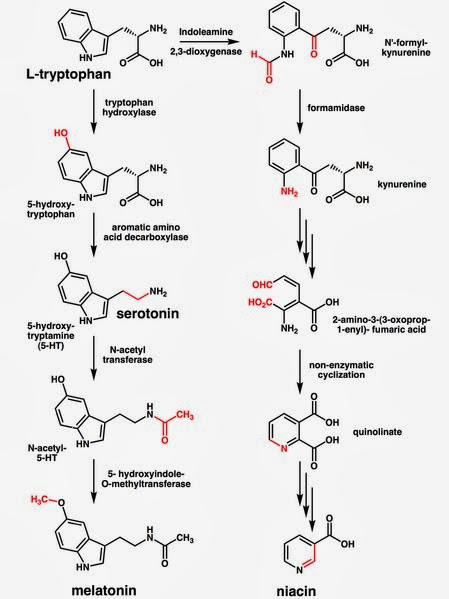
資料來源:維基百科
C.血清素(Serotonin)
I.大腦所產生之神經傳導物質,可使人有興奮的感覺
II.缺乏或功能不佳時造成心情不佳,可能導致憂鬱症及自殺等問題
III.在細胞間分泌不足或受體不足時都會造成憂鬱的感覺
IV.當情緒低落時,血清素回收運輸體會受到刺激而增加,吃掉更多分泌出來的血清素,而導致憂鬱
V. 憂鬱症或心情不好時可補充雞肉、牛肉、堅果類、香蕉…等食品,或是直接服用含serotonin的藥物。
D. 褪黑激素(Melatonin)
I.腦部松果體所分泌的激素,松果體的體積很小
II.其分泌受兩種因素影響:
i.光暗
ii.晝夜韻律
III. 愈年輕的人Melatonin分泌越多,老年人因為松果體退化而分泌量降低,睡眠時間因此縮短
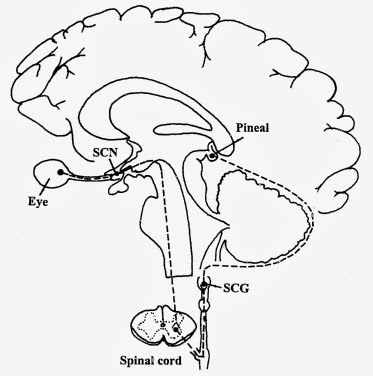
資料來源:芬蘭赫爾辛基
資料來源:維基百科
C.血清素(Serotonin)
I.大腦所產生之神經傳導物質,可使人有興奮的感覺
II.缺乏或功能不佳時造成心情不佳,可能導致憂鬱症及自殺等問題
III.在細胞間分泌不足或受體不足時都會造成憂鬱的感覺
IV.當情緒低落時,血清素回收運輸體會受到刺激而增加,吃掉更多分泌出來的血清素,而導致憂鬱
V. 憂鬱症或心情不好時可補充雞肉、牛肉、堅果類、香蕉…等食品,或是直接服用含serotonin的藥物。
D. 褪黑激素(Melatonin)
I.腦部松果體所分泌的激素,松果體的體積很小
II.其分泌受兩種因素影響:
i.光暗
ii.晝夜韻律
III. 愈年輕的人Melatonin分泌越多,老年人因為松果體退化而分泌量降低,睡眠時間因此縮短
資料來源:芬蘭赫爾辛基
▼胺基酸(amino acid)相關
顯示/隱藏(show/hide)
▼胺基酸應用(amino acid application)
顯示/隱藏(show/hide)
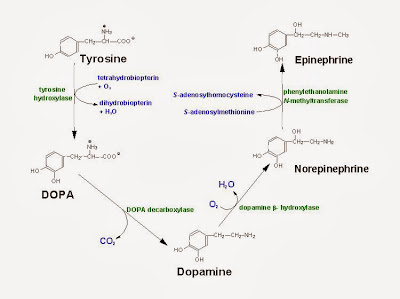
酪胺酸衍生物(Tyrosine derivatives)
A.Tyrosine是Dopamine(多巴胺)、Epinephrine(腎上腺素)、Norepinephrine(正腎上腺素)的前驅物
B.Tyrosine生成之Dopamine與神經傳導相關,分泌量不足或受體不足時會造成帕金森氏症
C.相關疾病
a.白化症
人類或動物在缺乏一種稱為Tyrosine hydroxylase的氧化酵素時,將無法製造出黑色素,導致白化症,患者的頭髮及皮膚均呈白色。白化症患者對光線異常敏感,易發生陽光灼傷、皮膚癌、畏光、視力差等症狀。其虹膜會呈紅色。
b.帕金森氏症 參見:多巴胺性神經元致病機制(Pathogenesis of DAergic neuron)
I.因為Dopamine分泌量過少或是另一端細胞上的接受器不足所導致
II.因為神經傳導差,會造成手腳顫抖、肌肉僵直、邊走邊流口水等現象
III.可服用二羥基苯丙胺酸(L-dihydroxyphenylalanine)及單胺氧化酶抑制劑(monoamine oxidase inhibitor)以催化Dopamine大量合成
IV.服用藥物並勤做復健可改善帕金森氏症的問題
▼胺基酸(amino acid)相關
顯示/隱藏(show/hide)
▼胺基酸應用(amino acid application)
顯示/隱藏(show/hide)
鳥胺酸衍生物(Ornithine derivatives)
A.Ornithine的衍生物
a.Ornithine可經由轉胺作用形成glutamate-γ-semialdehyde後再轉為glutamate
b.Ornithine可形成多胺類物質(如精胺spermine)
c.在ornithine轉變為arginine之後可再衍生出肌酸、磷酸肌酸、一氧化氮(nitric oxide)等物質
B.精胺(spermine)
a.與細胞增生(proliferation)與成長(growth)有關:原因是因為精胺分子本身跟細胞核內的染色體複製有關、可加速細胞生長與增生速率
b於腎臟有病變的病人中,有尿毒症的病人尿中精胺的量會較平常人高很多,且體溫及血壓會比常人低,這是由精胺的藥理功能所致:可降體溫和降血壓

資料來源:美國普度大學
▼胺基酸(amino acid)相關
顯示/隱藏(show/hide)
▼胺基酸應用(amino acid application)
顯示/隱藏(show/hide)
甘胺酸衍生物(glycine derivatives)
A.Benzoate(苯甲酸)是食品添加劑,可以在加入glycine的反應後形成hippurate(馬尿酸)
B.馬尿酸以往被當作檢視肝功能的指標物質,當肝臟代謝功能差,馬尿酸的含量便會提高。然而今日已被GOT、GPT指標取代

資料來源:aappublications
2.Creatine(肌酸)
2.Creatine(肌酸)
A.合成creatine的胺基酸:Gly、Arg、Met
B.合成路徑
a.首先arginine和glycine在腎臟反應並產生ornithine和glycocyamine後
b.再到肝臟與SAM(由methionine衍生而來,提供甲基)反應產生磷酸肌酸(creatine phosphate)
C.Creatine是以phosphocreatine (磷酸肌酸)的型式儲存
註:磷酸肌酸為高能儲存物質

▼胺基酸(amino acid)相關
顯示/隱藏(show/hide)
▼胺基酸應用(amino acid application)
顯示/隱藏(show/hide)
訂閱:
文章 (Atom)